
What Does This Settlement Email Mean? How to Read a Legal Notice (And Prove It’s Not a Scam)
TL;DR: The Bottom Line
- Most settlement notices look like spam, but many are real. Because they are sent in massive bulk by court-appointed administrators, they often lack the polished design we expect from legitimate companies.
- Look for your "Claim ID" or "Notice ID." This unique string of letters and numbers is your VIP pass to claiming your share of the settlement quickly.
- Always verify before you click. Never pay a fee to claim a settlement, and use tools like ClaimChowder.ai to help you track down official, court-approved sources safely.
We’ve all been there. You’re sorting through your junk mail or scrolling past your spam folder, and something catches your eye: a dense, jargon-heavy postcard or an email claiming you are part of a "Class Action Settlement." Your immediate thought? "Is this a scam?" It is completely normal to be skeptical. In fact, we encourage it. Scammers do try to mimic these notices. But the truth is, millions of legitimate, court-ordered notices are sent out every year, and ignoring them means leaving your own money on the table. If you're wondering, "What does this settlement email mean?" and trying to figure out if a class action notice is legitimate, you are in the right place. Let’s pull back the curtain on how the legal system works and translate that confusing postcard into plain English.
Why Do These Notices Look So... Sketchy?
When a class action lawsuit is settled, the court requires that the people affected (the "class members") are notified. Because lawsuits often involve millions of consumers, the court appoints a third-party company—called a Settlement Administrator—to handle the logistics. These administrators have to send out millions of emails and postcards on a tight budget. They aren't marketing agencies. Their goal isn't to make the email look pretty; their goal is to comply with strict legal requirements dictated by the court. That is why the emails often feature walls of tiny text, no company logos, and confusing legal jargon.
The Tear-Down: Anatomy of a Settlement Notice
Don't let the legalese intimidate you. Whether it’s an email or a postcard, every legitimate notice contains a few key pieces of information. Here is exactly where to look and what it all means:
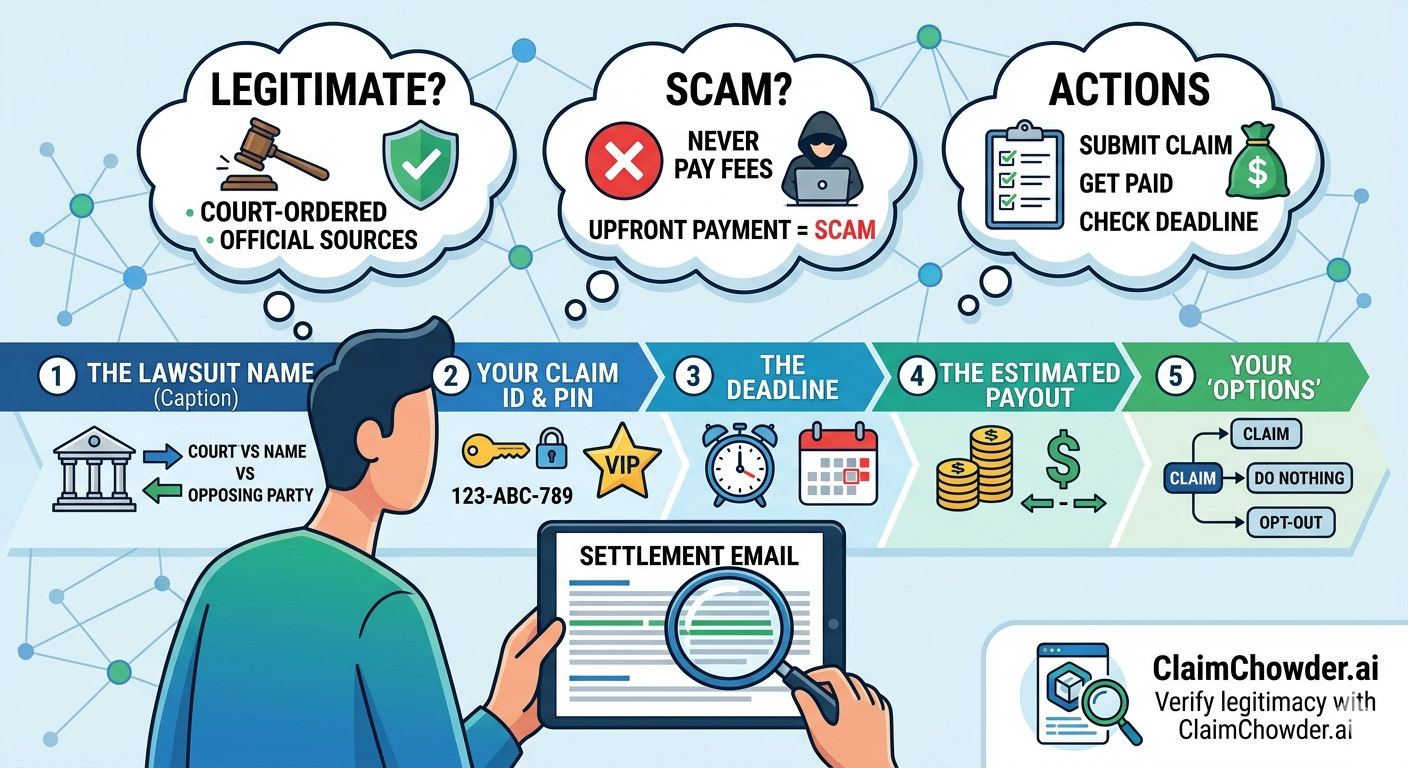
- The Lawsuit Name (The "Caption") At the very top, you will usually see a clunky title like Smith v. BigTech Corp., Case No. 12-cv-3456.
- What it means: This is just the official name of the lawsuit. It tells you who sued whom. It does not mean you are being sued. It means you might be entitled to compensation because of the lawsuit.
- Your Claim ID and PIN (Your Golden Ticket) Somewhere prominently on the notice—often near the top of an email or boxed out on a postcard—you will find a Claim ID, Notice ID, and sometimes a PIN.
- What it means: This is the most important part of the notice. Because the administrator already has your contact info (which is how they found you), they have pre-qualified you. Entering this ID on the official settlement website fast-tracks your claim and proves you are a verified class member.
- The Deadline (The "Bar Date") Look for bold text that says something like, “To receive a payment, you must submit a claim form by [Date].” * What it means: This is the absolute, hard-stop deadline. If you submit your claim one day late, your submission will be rejected. Always file as soon as you verify the notice is real.
- The Estimated Payout (Managing Expectations) The notice will outline what the settlement provides. It might say, "Class members are eligible to receive up to $50," or "Payments will be distributed pro-rata."
- What it means: "Pro-rata" simply means the total settlement fund is divided equally among everyone who actually files a claim. Because these funds are so large, there is almost always plenty of money to go around for everyone affected. However, payout amounts are estimates, never guarantees.
- Your "Options" Section The notice will list your rights, usually presented as: Submit a Claim, Opt-Out (Exclude Yourself), Object, or Do Nothing.
- What it means: For everyday consumers looking to get their extra cash, "Submit a Claim" is the action step. If you "Do Nothing," you get zero dollars, but you still give up your right to sue the company over this specific issue in the future.
How to Tell if a Class Action Notice is Legitimate
Skepticism is your best defense against actual scams. Here is a quick checklist to verify that a notice is real:
- No upfront fees: A legitimate settlement will never ask you to pay money, provide a credit card number, or pay a "processing fee" to get your payout.
- Check the source: Look at the sender's email address. Legitimate notices usually come from domain names specifically created for the settlement (e.g., noreply@BigTechSettlement2024.com), rather than a Gmail or Yahoo address.
- Use ClaimChowder.ai: You don't have to navigate the confusing web of legal notices alone. Our platform does the heavy lifting to track down official, court-approved settlements. If you get a postcard and aren't sure if it's real, you can use our tools to verify its legitimacy and safely navigate to the official filing source.
Don't let confusing legalese stand between you and the money you are owed. By knowing what to look for, you can claim your cash with confidence.
Disclaimer: The content on ClaimChowder.ai is provided for educational and informational purposes only and does not constitute legal advice. Reading this blog or using our platform does not create an attorney-client relationship. If you need specific legal guidance, please consult a qualified attorney.