
Spotting the Fakes: How to Tell a Legitimate Settlement from a Phishing Scam
TL;DR: The Bottom Line
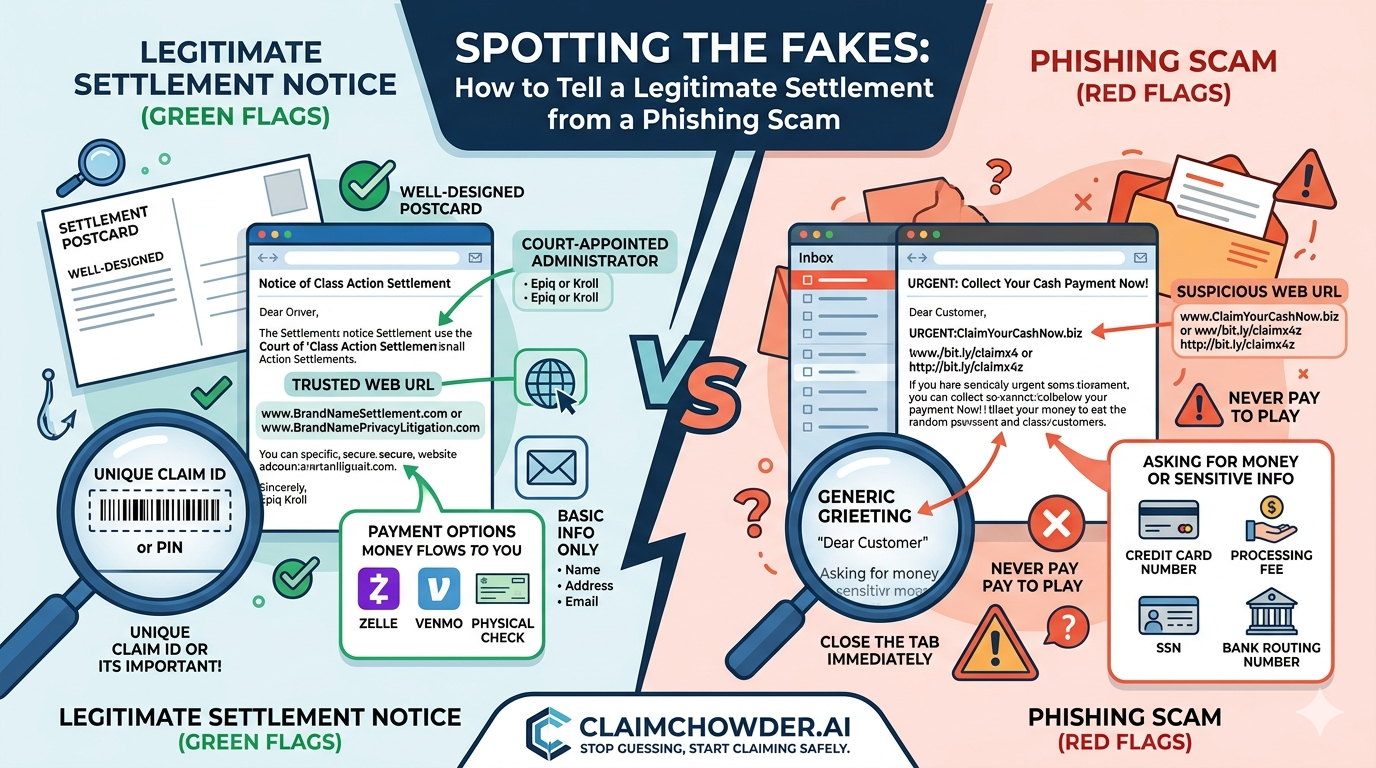
- Check the web URL: Legitimate settlements use specific, secure website addresses managed by court-appointed administrators, not random strings of letters or sketchy domains. Always do your due diligence.
- Never pay to play: A real class action settlement will never ask you for a credit card number, a processing fee, or an upfront payment to claim your money.
- Look for a Claim ID: Official email or postcard notices almost always include a unique alphanumeric "Claim ID" or "Notice ID" tied specifically to you.
You open your inbox and see an email with the subject line: "Notice of Class Action Settlement: You May Be Entitled to a Cash Payment." It mentions a smart home gadget you bought a few years ago or a photo app you used to back up your camera roll. Your first thought? This has to be a phishing scam. It is completely normal to be skeptical. We have all been trained to guard our digital data, and clicking a link from an unknown sender promising "free money" breaks every rule of internet safety. But here is the reality: millions of dollars in legitimate settlement money go unclaimed every year simply because people assume the real notices are fake. For years, massive corporations used "mandatory arbitration" clauses in their terms of service to block consumers from banding together in court. But recently, the tables turned. Plaintiff lawyers figured out how to weaponize those clauses by filing tens of thousands of individual arbitration claims all at once. This "mass arbitration" strategy threatened companies with tens of millions of dollars in administrative filing fees alone. Because of this massive shift in legal leverage, there are more legitimate consumer payouts happening now than ever before. So, how do you run a quick class action scam check? If you are staring at a notice and wondering, "Is [settlement name] legit?" here are the exact hallmarks to look for.
1. Do Your Due Diligence and Check the Web URLs
The court doesn't just hand a pile of cash to the company that got sued and say, "Go pay everyone." Instead, the judge appoints a neutral, third-party company called a "Settlement Administrator." (Common, real ones include Epiq, Kroll, Verita and Angeion Group). These administrators build custom, temporary websites just for processing claims.
- The Green Flag: Real URLs are usually straightforward and directly name the lawsuit, like www.[BrandName]Settlement.com or www.[BrandName]PrivacyLitigation.com.
- The Red Flag: Scammers use misspellings, strange domain endings (like .biz or .cc), or URLs that don't match the lawsuit name at all. If the link looks like a random string of numbers and letters, do not click it.
2. They Will Never Ask You for Money
This is the golden rule of class actions. You are the victim in this scenario; the money flows to you, never away from you.
- The Green Flag: A legitimate claim form will only ask how you want to be paid—usually offering options like an electronic check, Zelle, Venmo, or a physical check mailed to your address.
- The Red Flag: If a website asks for a "processing fee," requests your credit card number, or tells you to wire money to "release your funds," close the tab immediately. It is a scam.
3. They Don't Need Your Life Story (Usually)
To claim a standard consumer settlement, administrators just need to verify you are a real person and know where to send the cash.
- The Green Flag: They will ask for your name, mailing address, email, and a digital signature swearing you bought the product or used the service.
- The Red Flag: Unless the settlement payout is exceptionally large (over $600, which triggers tax reporting requirements), they should not be asking for your Social Security Number. They also don't need your bank account routing numbers or your passwords.
4. Look for the Unique "Claim ID"
When companies settle, they often have to hand over customer lists so the administrator can notify people directly.
- The Green Flag: If you received an email or a postcard, look for a "Notice ID," "Claim ID," or "PIN" printed near the top. You use this code to log into the settlement website. This proves the administrator already has you on file as an affected consumer.
- The Red Flag: Generic emails that say "Dear Customer" without any unique identifying numbers are more likely to be spam. (Note: You can still file a claim without an ID if you find a settlement online, but an email notice without one is suspicious).
Stop Guessing and Let ClaimChowder.ai Do the Work
Trying to verify legal documents and check URLs on your own can be exhausting. It is exactly why so many people just delete the emails and walk away. You shouldn't need a law degree to figure out if a link is safe. At ClaimChowder.ai, we aim to streamline this process. We do the initial legwork to track down the official, court-approved settlement websites and organize them in one place. While we always encourage you to review the details and do your own due diligence, our goal is to point you directly to the legitimate administrators so you can file your claim safely and skip the guesswork. Ready to see what you're owed? Check our database today to find open settlements and connect directly to the official claim forms.
Disclaimer: The content on ClaimChowder.ai is provided for educational and informational purposes only and does not constitute legal advice. Reading this blog or using our platform does not create an attorney-client relationship. If you need specific legal guidance, please consult a qualified attorney.