
Lawyers, Lead Plaintiffs, and You: Who Gets Paid What?
TL;DR
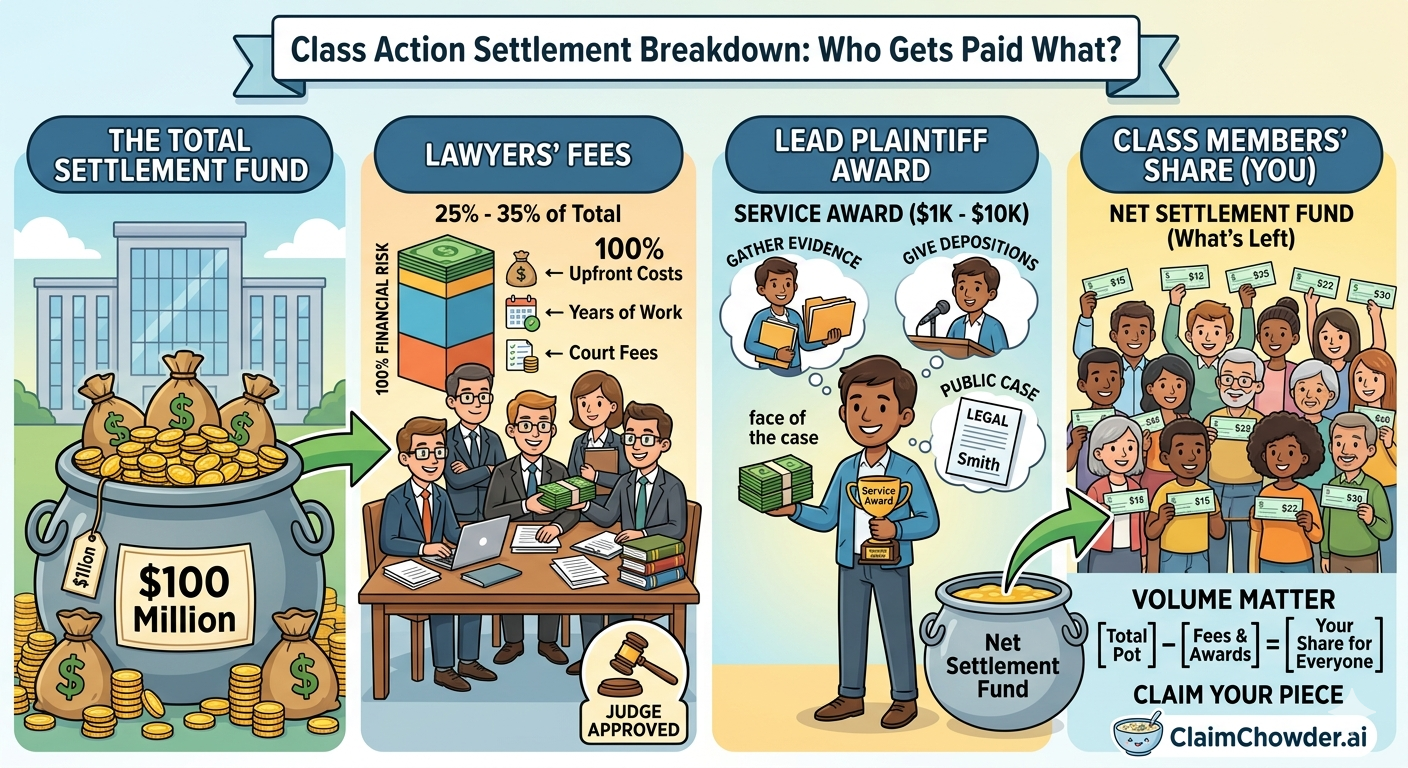
- The Lawyers: Usually receive 25% to 35% of the total settlement, but they take 100% of the financial risk and pay all upfront costs.
- The Lead Plaintiff: These are the "faces" of the case who can receive a service award (often $1,000–$10,000) for their extra time and effort.
- The Class Members: That’s you. You get a share of the remaining "Net Settlement Fund" after fees and expenses are deducted.
It’s the number one question we get: "If a company settles for $100 million, why am I only getting a check for $15? Is this a scam where only the lawyers get rich?"
It’s a fair question. When you see headlines about massive settlements, it can feel like the "little guy" is getting the short end of the stick. But if we pull back the curtain on how these cases actually work, the math starts to make a lot more sense.
Here is exactly how the money is divided when a class action settlement is finalized.
1. How Much Do Lawyers Get in Class Actions?
In most class actions, the lawyers work on a contingency fee basis. This means they don't charge the plaintiffs a single cent upfront. Instead, they agree to take a percentage of the final settlement if—and only if—they win.
Typically, lawyer fees range from 25% to 35% of the total settlement amount.
Why so much? Think of the law firm as a venture capitalist for your case. They spend years—and often hundreds of thousands of dollars of their own money—on expert witnesses, court filings, and thousands of hours of research. If they lose the case, they lose all that money. By taking a percentage, they are being compensated for taking on 100% of the financial risk so that you don’t have to.
The "Fairness" Check: Lawyers can't just pick a number and take it. A judge must review the requested fees and officially approve them to ensure they are "reasonable" based on the work performed and the benefit provided to the consumers.
2. Lead Plaintiff Compensation: The "Service Award"
You might notice one or two names listed at the very top of a lawsuit (e.g., Smith v. Big Corp). That person is the Lead Plaintiff (or Class Representative).
Unlike a regular class member who just fills out a 5-minute form to get a check, the Lead Plaintiff does the heavy lifting. They:
- Help the lawyers gather evidence.
- May have to sit for hours of depositions (answering questions under oath).
- Give up their privacy by having their name attached to a public lawsuit against a major company.
Because of this extra effort, the court often grants them a service award (also called an incentive award). While it varies by case, Lead Plaintiff compensation typically ranges from $1,000 to $10,000. It’s a way to thank them for being the "boots on the ground" that made the settlement possible for everyone else.
3. What’s Left for You? (The Net Settlement Fund)
Once the lawyers’ fees, court expenses, and Lead Plaintiff awards are taken out, the remaining money forms the Net Settlement Fund. This is the pool of money reserved for people like you—the class members.
The reason individual checks can sometimes feel small is simple math: Volume. If there is $50 million left in the fund, but 5 million people were affected by the company’s mistake, each person gets $10.
Is It Still Worth It?
Absolutely. While $15 might not buy a new car, it’s $15 you didn't have yesterday for a problem you might not even have known you had.
More importantly, class actions aren't just about the check—they are about accountability. When millions of people claim their small share, it adds up to a massive penalty for the company. It forces them to change their "dark pattern" subscriptions, fix their data privacy, or stop using misleading labels.
At ClaimChowder.ai, our job is to make sure you never miss out on your piece of that pie. We track the deadlines and the official forms so you can claim what’s yours in minutes.
Disclaimer: The content on ClaimChowder.ai is provided for educational and informational purposes only and does not constitute legal advice. Reading this blog or using our platform does not create an attorney-client relationship. If you need specific legal guidance, please consult a qualified attorney.