
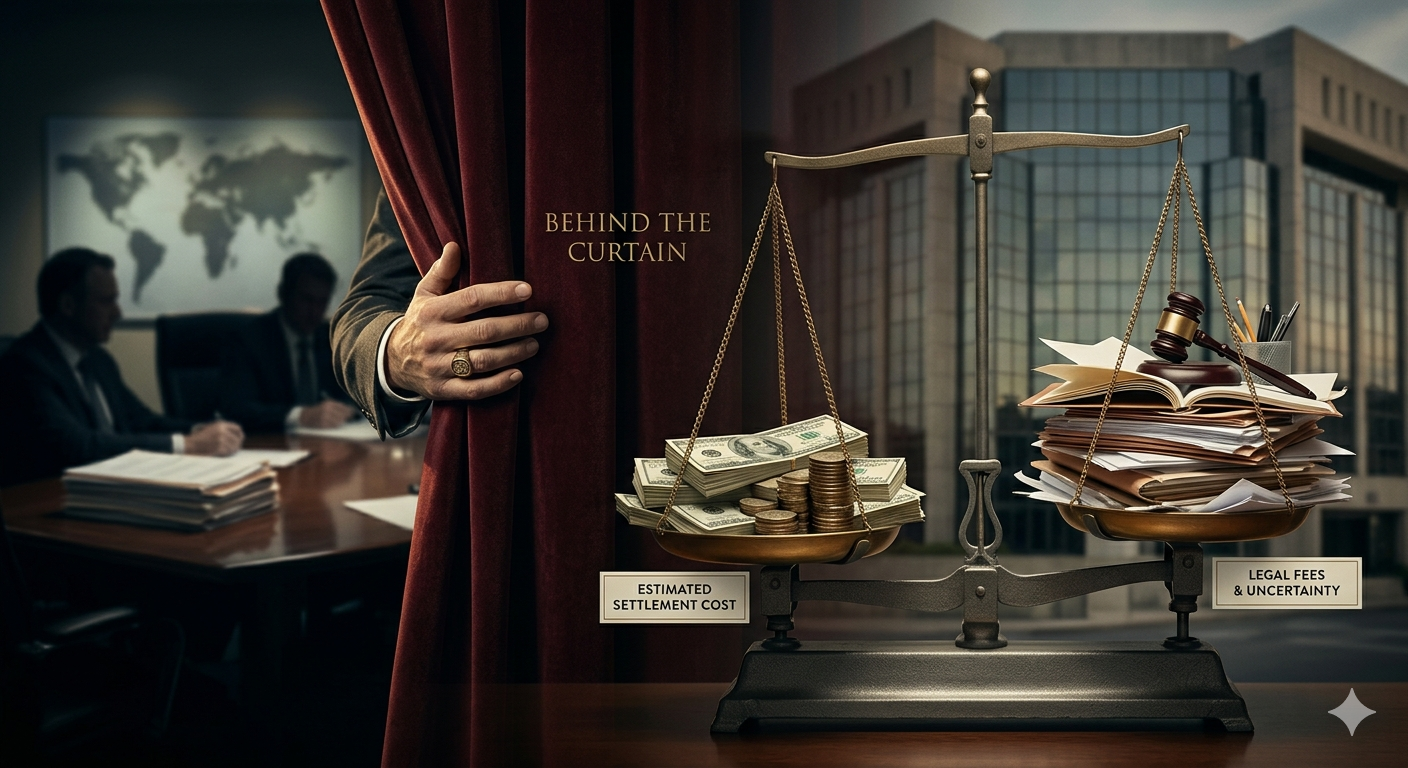
Behind the Curtain: Why Billion-Dollar Corporations Actually Prefer to Settle
TL;DR: The Bottom Line
- It’s Business, Not Charity: Corporations settle lawsuits because it is a predictable business expense, often cheaper than the "legal bill" of a long trial.
- Settling ≠ Admitting Guilt: Most settlements explicitly state the company denies any wrongdoing; they are simply paying to make the legal "uncertainty" go away.
- Your Claim is a Transaction: When you claim a settlement, you are participating in a finished legal contract, not receiving a "scam" handout.
If you’ve ever seen an ad for a class action settlement and thought, "Why would a billion-dollar company just hand out money? This has to be a scam," you aren't alone. It feels too good to be true because, in our daily lives, people don't usually give away cash unless they have to.
But in the world of high-stakes corporate law, settling is often the smartest financial move a company can make. At ClaimChowder.ai, we believe that understanding why do companies settle lawsuits is the first step toward realizing these payouts are a legitimate part of the American legal system. Here is the "behind the curtain" look at the corporate math that leads to your next settlement check.
1. The "Certainty" Factor (Investors Hate Surprises)
The biggest enemy of a major corporation isn't necessarily a lawsuit—it’s uncertainty. Billion-dollar companies are answerable to shareholders and boards of directors. A pending lawsuit is like a dark cloud hanging over a company's stock price. If a company is trying to engage in Mergers & Acquisitions (M&A)—essentially buying or selling a business—a massive, unresolved "class action" is a giant red flag that can tank the deal.
By settling, the company turns a "huge, scary unknown" into a "fixed, predictable number." Investors prefer a company that says, "We paid $50 million to resolve this," over a company that says, "We might owe $5 billion, but we won’t know for three years."
2. The Math of Legal Fees
The class action payout process is expensive for everyone, but for a corporation, the "cost of defense" is astronomical. We’re talking about thousands of hours from elite law firms charging $1,000+ per hour. Often, the cost of fighting a lawsuit for five years—even if the company is 100% sure they would win—is actually higher than the cost of just settling it today. To a Chief Financial Officer (CFO), settling isn't an admission of defeat; it’s a cost-saving measure.
3. Avoiding the "Nuclear Verdict"
Juries are unpredictable. Even with the best lawyers in the world, a company faces the risk of a "nuclear verdict"—a massive, multi-billion dollar judgment that could bankrupt the business.
When a company settles, they are essentially buying "insurance" against a worst-case scenario. They choose to pay a set amount now to ensure they never have to pay a catastrophic amount later.
4. "Settling" is Not the Same as "Guilty"
This is the part that confuses most people. You will almost always see this phrase in the official settlement documents:
"The Defendant denies all allegations of wrongdoing and is settling this matter to avoid the expense and inconvenience of further litigation."
In plain English? They are paying to stop the headache. Because they don't have to admit they did anything wrong, they protect their brand reputation while ending the legal battle.
How ClaimChowder.ai Fits In
We know the legal system feels like a maze designed to keep you out. But now that you know companies settle as a routine business transaction, you can see these payouts for what they are: money that has been legally set aside for consumers.
ClaimChowder.ai doesn't just find "free money"—we find the official, court-approved business transactions that you are legally entitled to join. We do the heavy lifting of monitoring the courts so you don't have to.
Disclaimer: The content on ClaimChowder.ai is provided for educational and informational purposes only and does not constitute legal advice. Reading this blog or using our platform does not create an attorney-client relationship. If you need specific legal guidance, please consult a qualified attorney.
Curious if you're eligible for a piece of a recent corporate settlement? Let us do the digging for you. One quick search could reveal money waiting in your name.